Free Risk Assessment and Method Statement (RAMS) Template
RAMS is industry shorthand for a risk assessment and a method statement kept together. The law requires the risk assessment (MHSWR 1999 reg 3) and, under CDM 2015, planning and information for your workers; RAMS is the usual way principal contractors ask to see both. This template gives you the risk assessment table and the step by step method in one document.
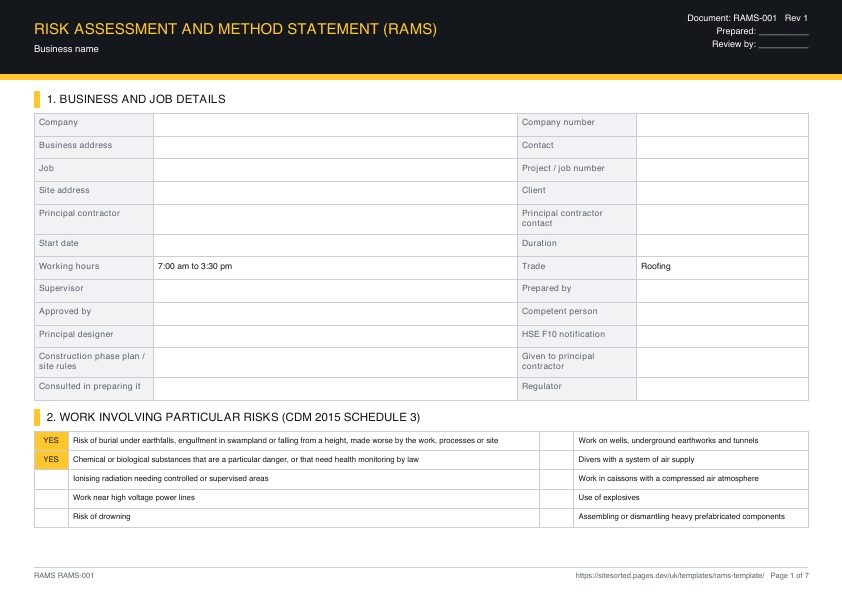
Risk Assessment and Method Statement template
Word (.docx, editable) and PDF (A4, print ready). No email needed.
When you need a RAMS
- Every employer and relevant self-employed person must make a suitable and sufficient assessment of the risks of their work (MHSWR 1999 reg 3(1) and (2)).
- If you employ 5 or more people, you must record the significant findings and any group of employees identified as especially at risk (reg 3(6)).
- On construction projects, contractors must plan, manage and monitor their work and give workers information on the risks identified by that assessment (CDM 2015 reg 15(2) and 15(9)).
- Arrangements for demolition, dismantling or structural alteration must be recorded in writing before the work begins; HSE says this is usually done with a method statement.
- Principal contractors commonly ask for RAMS before work starts so the work can fit the construction phase plan; contractors must follow the parts of that plan relevant to their work (reg 15(3)).
What goes in each field
| Field | What to write | Example |
|---|---|---|
| Project, client and principal contractor | Site address, client, principal contractor and the site contact who will receive and review the RAMS. | 12 Mill Lane, Leeds LS6; client: private owner; PC: Brookside Build Ltd, site manager Tom Hale |
| Scope of work | Exactly what you will do, where, and what is excluded. A reviewer should be able to tell from this line whether the RAMS fits the job. | Strip and replace concrete interlocking tiles on the rear roof slope; battens and felt where rotten; no chimney work |
| Hazards | Things on this job that could cause harm, by task. | Fall from the eaves; tiles or tools falling onto the garden path; silica dust from cutting tiles |
| Who might be harmed and how | Workers, other trades, residents and the public, and the way each could be hurt. | Roofers: fall of 5 m to the patio. Residents: struck by falling tiles at the back door |
| Risk rating before and after controls | Likelihood times severity on a 5 by 5 matrix, with the key printed so the reviewer knows what the numbers mean. | Fall from eaves: 3 x 5 = 15 Very high before; 1 x 5 = 5 Medium after |
| Control measures | What you will do, most effective first. For work at height: avoid it, then prevent a fall with existing places or equipment, then minimise the distance and consequences. | Scaffold with double guardrail and toe board at the eaves before stripping; tile cutting with on-tool water suppression |
| Method statement: sequence of work | The job step by step, in the order it will be done, saying how each step is done safely and with what equipment. | 1. Scaffold erected and handed over. 2. Stage tiles on the scaffold lift. 3. Strip a strip of tiles at a time from the ridge down. |
| Plant, equipment and materials | What you will bring and use, with any inspection or certificate a reviewer will ask for. | Scaffold (inspected and tagged weekly), 110V disc cutter with water bottle, rubbish chute to skip |
| People, competence and supervision | Supervisor, crew, their cards and training, and how often the supervisor is on site. | Supervisor: Ryan Cole (SSSTS), on site daily; 2 roofers with CSCS cards |
| Emergency arrangements | First aider, nearest A&E, how the alarm is raised, and rescue from height. | 999; first aider Ryan Cole; A&E: Leeds General Infirmary; rescue from scaffold by internal ladder |
| Review, revision and briefing record | Revision number and date, what changed, who approved it, and signatures of everyone briefed. | Rev 2, 4 March: added skylight cover after survey. Briefed: R. Cole, L. Shaw, P. Okafor |
How to fill it in
- Visit the site and read the principal contractor's pre-start information and site rules.
- Write the scope in one or two lines so it is clear what the RAMS covers and what it does not.
- Work through the HSE five steps: identify hazards, decide who might be harmed and how, and rate each risk.
- Write controls for each hazard, most effective first, and rate the risk again with the controls in place.
- Write the method statement as numbered steps in the order the work happens, naming the equipment and the controls used at each step.
- Add people, competence, plant inspections, emergency arrangements and welfare.
- Have it approved, send it to the principal contractor, and brief the crew before work starts. Get signatures.
- Review it if anything significant changes and record the revision.
Method statement template
A method statement is the "how" part of RAMS. It sets out, in the order the job is done, each step, the equipment used and the controls in place at that point. HSE describes it as drawing together the hazards and controls from the risk assessment and setting out in a logical sequence exactly how the job is carried out.
You need one in writing before demolition, dismantling or structural alteration. For other work it is not required by law, but principal contractors ask for it on most jobs, and it is the easiest way to brief a crew. Diagrams help. Revise it when the job or the site changes.
Risk assessment template
The risk assessment is the legal core. MHSWR reg 3 requires every employer and relevant self-employed person to assess the risks of their work; with 5 or more employees, the significant findings must be written down.
HSE sets out five steps: identify the hazards, decide who might be harmed and how, assess the risk and decide on controls, record your findings, and review the controls. The template columns follow those steps: hazard, who is at risk and how, risk before, controls, risk after, and who does what. Use it on its own for simple jobs; pair it with a method statement when a principal contractor or the task needs one.
Why RAMS get rejected
- The method statement is only a list of headings that repeats the risk table and never says how the work is done.
- The method sequence does not match the risk assessment, for example the method strips the roof before the scaffold is handed over.
- Residual risk is still High after controls with no extra measures or explanation.
- It reads as copied: another firm, another address, or wording that does not fit UK sites. HSE warns that copying an example and adding your name does not satisfy the law.
- Work on an older building with no reference to an asbestos survey.
- Plant and access equipment listed with no inspection, thorough examination or competence evidence.
- No briefing record, no revision history, or no named supervisor.
Filled RAMS examples
Questions
Is a free RAMS template legally compliant?
A template on its own is not compliant or non-compliant: the law judges the assessment, not the form. MHSWR reg 3 requires a suitable and sufficient assessment of your own work, so the template only helps once it reflects your site, your crew and your method. HSE says do not just copy an example and add your company name.
Do RAMS need a risk matrix?
No law requires a risk matrix in RAMS. HSE asks you to decide how likely harm is and how serious it could be, and a 5 by 5 matrix is a common way to show that. If you use scores, print the key so the reviewer can read them.
Source: HSE: Steps needed to manage risk
Can I use AI-generated RAMS?
Yes, as a first draft, but you remain responsible for the assessment. Read every line against the actual job, delete anything that does not apply, fix any non-UK terms, and check the method matches how your crew will really do the work before you sign or send it.
Source: MHSWR 1999 regulation 3
Who signs RAMS?
The author and an approver from your firm sign it, and every worker briefed on it signs the briefing record. The regulations do not prescribe signatures, but CDM requires you to give workers information on the risks, and a signed briefing record is how you show you did it. Many principal contractors also sign to accept it.
Source: CDM 2015 regulation 15
Do it on your phone instead
Fill it in by tapping, the crew signs with a finger, and you get a clean PDF.