SiteSorted
Roofing · United Kingdom

Method statement for re-roofing

You must assess the risks of re-roofing and record the significant findings if you employ 5 or more people. On CDM sites the principal contractor will ask for RAMS before you start.

RAMS cover the hazards, who could be harmed and how, the controls and the safe sequence of work, and the crew is briefed and signs. The main hazards are falling from a roof edge, falling from height, disturbing asbestos and scaffold collapse or fall from scaffold.

RAMS example: re-roofing

This is a complete RAMS for re-roofing, with 11 job steps. Open it in the builder to add your site, crew and signatures, change anything, and download a PDF. Or download the free Word template below and fill it in by hand.

Risk Assessment and Method Statement (RAMS)
Re-roof: strip and replace a roof · Roofing · Example
Document RAMS-001 · Rev 1

Risk assessment

#ActivityHazardsWho might be harmedRisk beforeControlsRisk after
1Check the asbestos survey and get any asbestos roof removed first, by an HSE licensed asbestos contractor where the work is licensable
  • Disturbing asbestos
Workers, Occupants, PublicVery high (15)
  • Before work on any building built before 2000, check the refurbishment and demolition asbestos survey for the work area (HSE HSG264). If there is none, presume asbestos is present or have it sampled before you start. Eliminate
  • Seal off the work area and keep everyone else out. Isolate
  • If asbestos must be disturbed, keep it wet, use hand tools not power tools, and clean up with an H-class vacuum. Control (engineering)
  • Most asbestos insulation, coatings and insulating board need a licensed contractor. Notifiable non-licensed work is notified to HSE before it starts. Other work needs trained workers and controls. Control (procedures)
  • Stop work straight away if you find suspect asbestos. Do not touch it and tell your supervisor. Control (procedures)
  • Wear a fit-tested FFP3 mask (or better) and disposable type 5 coveralls. PPE
Medium (5)
2Check the weather and power lines, and plan the crane, hoist and skip positions
  • Contact with overhead power lines
  • Strong wind and storms
  • Crane and lifting failure
Workers, Plant operators, PublicHigh (12)
  • Ask the distribution network operator (DNO) to turn off, move or insulate the lines before work starts. Eliminate
  • Use non-conductive (fibreglass) ladders near any power lines. Reduce / substitute
  • Mark the safe distance with flags, tape or goal posts and keep all plant and people outside it. Isolate
  • Follow HSE GS6: barriers, goal posts under the lines and a permit for work near them. Control (procedures)
  • Use a dedicated spotter whenever plant moves or raises anything near lines. Control (procedures)
  • Treat all lines as live. If plant touches a line, stay in the cab and keep everyone well away. Control (procedures)
  • Check the forecast each morning and plan work at height and lifting around the weather. Eliminate
  • Tie down or weigh down loose sheets, panels, boards and rubbish at the end of each shift. Control (engineering)
  • Set wind limits for roof work, platforms and cranes, using the manufacturer's limits, and stop when they are reached. Control (procedures)
  • Stop work and get down in lightning. Wait 30 minutes after the last thunder before going back up. Control (procedures)
  • Check scaffold, fencing and edge protection after strong wind before anyone uses them. Control (procedures)
  • Barricade the lift zone and keep everyone out from under the load. Isolate
  • Use a crane rated for the load at the radius, set up on firm ground with outrigger pads. Control (engineering)
  • Check slings, chains, shackles and hooks before use. Remove anything damaged or not tagged. Control (engineering)
  • Have a lift plan made by an appointed person, following LOLER. Control (procedures)
  • Use CPCS or NPORS carded crane operators, slingers and signallers. Control (procedures)
Medium (5)
3Erect full perimeter scaffold edge protection, a waste chute and an exclusion zone below
  • Falling from a roof edge
  • Scaffold collapse or fall from scaffold
  • Falling tools and materials
  • Public entering the work area
Workers, People below, Public, ChildrenVery high (20)
  • Do what you can from the ground or from a scaffold at the gutter line, for example pre-assemble parts on the ground. Eliminate
  • Install edge protection or guardrails on all open roof edges before work starts. Isolate
  • Use a perimeter scaffold with handrails and toe boards along the eaves where practical. Control (engineering)
  • Where guardrails cannot be fitted, use fall restraint on certified roof anchors so workers cannot reach the edge. Control (engineering)
  • Scaffold is built, altered and taken down only by CISRS-carded scaffolders, to TG20 or a specific design. Control (engineering)
  • Fit guardrails, mid rails and toe boards on every working platform. Control (engineering)
  • Use mobile scaffolds only on firm, level ground with castors locked and outriggers fitted. Never move one with anyone on it. Control (engineering)
  • Mobile towers are built by PASMA-trained workers. Control (procedures)
  • Inspect the scaffold before first use, after any change or bad weather, and at least every 7 days. Record it on the tag and register. Control (procedures)
  • Barricade and sign the drop zone under overhead work so nobody walks beneath. Isolate
  • Fit toe boards, kick plates and mesh screens on scaffolds and edges. Control (engineering)
  • Falling tools and materials: see step 5 for the full controls Control (procedures)
  • Fence off the site with secure temporary fencing and lock the gates when you leave. Isolate
  • Give pedestrians a safe, marked path around the work, with ramps for prams and wheelchairs. Isolate
  • Use hoarding, covered walkways or catch fans where work is above public areas. Control (engineering)
  • Put signs at each entry: site name, contact number and "No unauthorised entry". Control (procedures)
Medium (8)
4Strip the old roof in sections so the building stays covered if rain comes
  • Strong wind and storms
  • Falling through a fragile roof or skylight
  • Lifting and carrying heavy loads
  • Cuts from sharp edges
Workers, Public, People belowVery high (15)
  • Do not carry large sheets on roofs in wind. Control (procedures)
  • Wear a hard hat with a chin strap at height in windy conditions. PPE
  • Strong wind and storms: see step 2 for the full controls Control (procedures)
  • Work from underneath or from a MEWP so nobody stands on the fragile roof. Eliminate
  • Cover or guard every skylight and fragile sheet with a fixed, marked cover or mesh before work starts. Isolate
  • Use safety nets or a boarded platform under the work, and staging or crawl boards to spread the load on fragile surfaces. Control (engineering)
  • Use fall arrest on rated anchors when working near fragile areas. Control (engineering)
  • Plan to avoid carrying: have materials delivered, and old items picked up, as close as possible to where they are used. Eliminate
  • Use lighter or smaller loads: order smaller bags and shorter lengths, and drain or break down old items before moving them. Reduce / substitute
  • Lifting and carrying heavy loads: see step 7 for the full controls Control (procedures)
  • Deburr or cover sharp edges, and fit edge protectors on exposed sheet metal. Control (engineering)
  • Use knives with retractable or self-retracting blades. Control (engineering)
  • Cut away from your body and keep your other hand clear. Control (procedures)
  • Put used blades in a blade bin or sharps container. Control (procedures)
Medium (6)
5Lower waste in the chute or by crane, never throw it off
  • Falling tools and materials
  • Crane and lifting failure
  • Poor housekeeping and waste
Workers, Public, People below, VisitorsHigh (12)
  • Barricade and sign the drop zone under overhead work so nobody walks beneath. Isolate
  • Fit toe boards, kick plates and mesh screens on scaffolds and edges. Control (engineering)
  • Use catch fans, debris netting or covered walkways where people pass below. Control (engineering)
  • Tether hand tools when working at height. Control (engineering)
  • Keep platforms tidy. Do not stack materials near edges or above toe board height. Control (procedures)
  • Use tag lines to control loads and agree on clear radio or hand signals. Control (procedures)
  • Stop lifting in high wind or when the operator cannot see the signaller. Control (procedures)
  • Never ride on a load or hook. Control (procedures)
  • Crane and lifting failure: see step 2 for the full controls Control (procedures)
  • Order materials to size and send packaging back where you can. Eliminate
  • Put skips and waste chutes close to the work. Control (engineering)
  • Clean as you go, and do a full clean up at the end of each day. Control (procedures)
  • Keep exits, stairs and walkways clear at all times. Control (procedures)
  • Stack materials neatly on level ground, away from edges. Control (procedures)
  • Use a registered waste carrier and keep waste transfer notes for at least 2 years. Keep hazardous waste such as asbestos separate, with consignment notes (special waste in Scotland). Control (procedures)
Medium (8)
6Check and repair the roof framing, guarding any gaps
  • Structural collapse during alterations
  • Falling from height
Workers, Occupants, People belowVery high (20)
  • Get an engineer to check before removing any wall, beam, post or bracing that may be load-bearing. Eliminate
  • Keep everyone clear of the area under and next to the work. Isolate
  • Install temporary props, needles or shoring as designed before removing any support. Control (engineering)
  • Follow the engineer's sequence. Do not change it without approval. Control (procedures)
  • Check props daily. Do not remove them until the permanent support is in and approved. Control (procedures)
  • Wear a hard hat and safety boots. PPE
  • Do the work from the ground where you can, for example pre-assemble on the ground or use extension poles. Eliminate
  • Install guardrails or edge protection on all open edges before work starts. Isolate
  • Falling from height: see step 7 for the full controls Control (procedures)
Medium (5)
7Fit the roofing underlay and battens, with safety nets or a boarded platform under any open roof where someone could fall through
  • Falling from height
  • Lifting and carrying heavy loads
Workers, People belowVery high (20)
  • Do the work from the ground where you can, for example pre-assemble on the ground or use extension poles. Eliminate
  • Install guardrails or edge protection on all open edges before work starts. Isolate
  • Use a scaffold, mobile tower or MEWP instead of working off a ladder. Control (engineering)
  • Where edge protection is not practical, use a fall restraint or fall arrest system on a rated anchor point. Control (engineering)
  • Have a rescue plan so a worker hanging in a harness can be brought down within minutes. Control (procedures)
  • Wear a full body harness with a shock-absorbing lanyard, clipped on at all times when using fall arrest. PPE
  • Plan to avoid carrying: have materials delivered, and old items picked up, as close as possible to where they are used. Eliminate
  • Use lighter or smaller loads: order smaller bags and shorter lengths, and drain or break down old items before moving them. Reduce / substitute
  • Use trolleys, pallet jacks, hoists, vacuum lifters or plant instead of carrying by hand. Control (engineering)
  • Use a two-person lift for anything heavy, long or awkward. Plan the route first and clear it. Control (procedures)
  • Keep the load close, back straight and no twisting. Turn with your feet. Control (procedures)
  • Rotate tasks and take breaks on long lifting jobs. Control (procedures)
  • Wear gloves for grip and safety boots to protect your feet. PPE
Medium (6)
8Land new roofing materials by crane or hoist, spreading loads across the frame
  • Crane and lifting failure
  • Structural collapse during alterations
Workers, Public, OccupantsHigh (10)
  • Wear a hard hat, hi-vis, gloves and safety boots. PPE
  • Crane and lifting failure: see step 2 for the full controls Control (procedures)
  • Structural collapse during alterations: see step 6 for the full controls Control (procedures)
Medium (5)
9Lay the new roof, taking breaks in heat and sun
  • Lifting and carrying heavy loads
  • Heat stress
  • Sun exposure (UV)
WorkersHigh (12)
  • Lifting and carrying heavy loads: see step 7 for the full controls Control (procedures)
  • Schedule heavy work for the cooler part of the day. Eliminate
  • Provide shade over work and rest areas, and fans or cooling in roof spaces. Control (engineering)
  • Supply cool drinking water close by and drink a cup every 15 to 20 minutes. Control (procedures)
  • Take regular rest breaks in the shade, more often as it gets hotter. Control (procedures)
  • Let new and returning workers build up to full work in the heat over about a week. Control (procedures)
  • Plan outdoor work for early morning or late afternoon when UV is lower. Eliminate
  • Put shade covers over fixed work areas. Control (engineering)
  • Check the UV index each day. Use sun protection when it is 3 or higher. Control (procedures)
  • Check your skin regularly and see a doctor about any new or changing spots. Control (procedures)
  • Wear a broad-brim hat or hard hat brim, long sleeves, sunglasses and SPF 30 or higher sunscreen, reapplied every 2 hours. PPE
Medium (8)
10Fit flashings, ridge tiles, gutters and downpipes
  • Injury from power tools
  • Angle grinder injuries
  • Cuts from sharp edges
Workers, People nearbyHigh (12)
  • Keep all guards fitted and working. Never tie back or remove a guard. Control (engineering)
  • Clamp or secure the work piece. Do not hold it by hand. Control (engineering)
  • Only trained, competent people use power tools, following the maker's instructions. Control (procedures)
  • Check tools before use. Unplug or remove the battery before changing blades or bits. Control (procedures)
  • No loose clothing, jewellery or long hair near spinning parts. Control (procedures)
  • Use a guarded saw or a different tool where you can. Reduce / substitute
  • Keep the guard on and use the side handle. Never remove the guard. Control (engineering)
  • Use the right disc for the job, rated for the grinder's speed. Check it for cracks first. Control (procedures)
  • Only trained people change discs, with the grinder unplugged or the battery out. Control (procedures)
  • Keep both hands on the grinder and let the disc stop before putting it down. Control (procedures)
  • Use two people to handle large sheets of metal or glass. Control (procedures)
  • Wear cut-resistant gloves and long sleeves. PPE
  • Cuts from sharp edges: see step 4 for the full controls Control (procedures)
Medium (8)
11Clean the roof and site, then dismantle scaffold once the roof is signed off
  • Poor housekeeping and waste
  • Scaffold collapse or fall from scaffold
Workers, Visitors, Public, People belowVery high (15)
  • Wear gloves when handling waste. PPE
  • Poor housekeeping and waste: see step 5 for the full controls Control (procedures)
  • Do not overload platforms. Know the duty rating and keep material stacks over the standards. Control (procedures)
  • Never remove ties, braces, guardrails or boards. Only the scaffolder alters the scaffold. Control (procedures)
  • Wear a hard hat and safety boots on and around the scaffold. PPE
  • Scaffold collapse or fall from scaffold: see step 3 for the full controls Control (procedures)
Medium (5)

Method statement: sequence of work

  1. Check the asbestos survey and get any asbestos roof removed first, by an HSE licensed asbestos contractor where the work is licensable
  2. Check the weather and power lines, and plan the crane, hoist and skip positions
  3. Erect full perimeter scaffold edge protection, a waste chute and an exclusion zone below
  4. Strip the old roof in sections so the building stays covered if rain comes
  5. Lower waste in the chute or by crane, never throw it off
  6. Check and repair the roof framing, guarding any gaps
  7. Fit the roofing underlay and battens, with safety nets or a boarded platform under any open roof where someone could fall through
  8. Land new roofing materials by crane or hoist, spreading loads across the frame
  9. Lay the new roof, taking breaks in heat and sun
  10. Fit flashings, ridge tiles, gutters and downpipes
  11. Clean the roof and site, then dismantle scaffold once the roof is signed off

PPE

Safety bootsFull body harness and lanyardSafety helmetCut-resistant glovesSafety glassesFFP3 dust maskEar defendersSun protection (sunscreen and neck cover)Half-mask respirator (P3 filters)CoverallsRigger glovesHi-vis vestFace shield

Plant and equipment

Tube and fitting or system scaffold: CISRS scaffolder card to erect, alter or dismantleMobile crane: CPCS or NPORS crane operator card, plus slinger signaller card; lift plan by an Appointed PersonTelehandler: CPCS or NPORS telehandler cardAngle grinder (disc cutter)Power drillTrailer

Permits and plans

Lift plan (LOLER reg 8)Roof access permitWork at height permit

Emergency

Call 999. Add the nearest A&E, the assembly point and the first aider for your site.

Sign-off

Supervisor and every worker sign to confirm they have read and understood this RAMS.
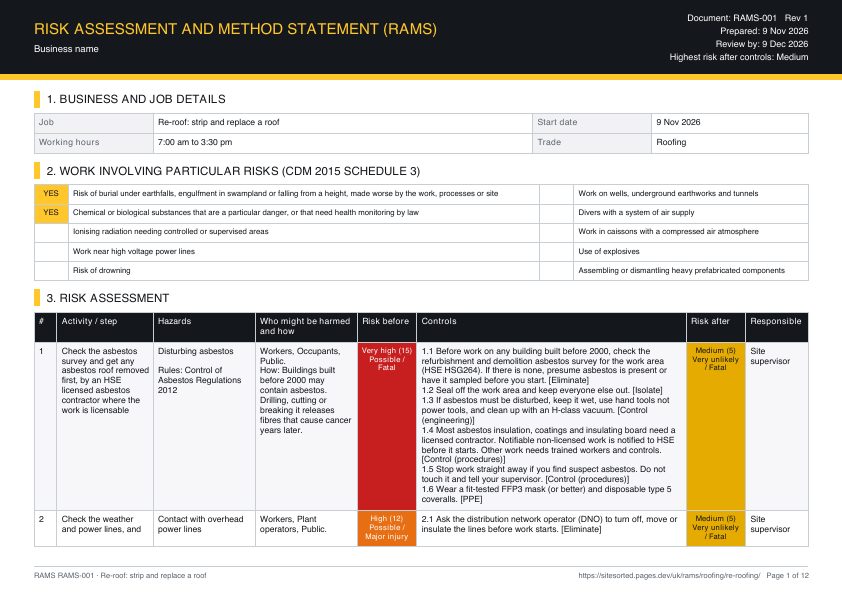
Page 1 of the free re-roofing RAMS template: business details, job steps with hazards, risk ratings and controls

Free RAMS template for re-roofing

Word (.docx) and PDF, A4 landscape, no email needed. Fill in your site details, then print or send it.

Make yours in 2 minutes

Same document, filled in for your job. Answer a few yes or no questions, the crew signs on the phone, and you send the PDF.

Start this RAMS

Pre-start checklist for re-roofing

Tick these off before work starts. They come from the hazards, permits and equipment in this job.

The safe sequence of work

  1. Check the asbestos survey and get any asbestos roof removed first, by an HSE licensed asbestos contractor where the work is licensable
  2. Check the weather and power lines, and plan the crane, hoist and skip positions
  3. Erect full perimeter scaffold edge protection, a waste chute and an exclusion zone below
  4. Strip the old roof in sections so the building stays covered if rain comes
  5. Lower waste in the chute or by crane, never throw it off
  6. Check and repair the roof framing, guarding any gaps
  7. Fit the roofing underlay and battens, with safety nets or a boarded platform under any open roof where someone could fall through
  8. Land new roofing materials by crane or hoist, spreading loads across the frame
  9. Lay the new roof, taking breaks in heat and sun
  10. Fit flashings, ridge tiles, gutters and downpipes
  11. Clean the roof and site, then dismantle scaffold once the roof is signed off

Hazards to watch on re-roofing

The hazards most specific to this job, and the step where each one comes up.

Step 4Falling through a fragile roof or skylightA worker steps on a skylight, clear sheet or old fibre cement roof and falls through to the floor below.
Step 2, 5, 8Crane and lifting failureA load falls or swings, or the crane tips, crushing workers under or near the lift.
Step 10Angle grinder injuriesThe disc shatters, binds or kicks back, causing deep cuts to legs and hands or eye injuries.
Step 3, 11Scaffold collapse or fall from scaffoldA scaffold that is badly built, overloaded or altered collapses or tips, or a worker falls from an unguarded platform.
Step 9Sun exposure (UV)Long hours in the sun cause sunburn, eye damage and skin cancer.
Step 2Contact with overhead power linesA ladder, MEWP, crane, tipper or long length of material touches or gets close to an overhead line and electrocutes people.
Very likelyLikelyPossibleUnlikelyVery unlikelyHow bad it could be: Negligible to FatalBA
Highest risk on re-roofing: Very high before controls (B), down to Medium after controls (A), on the United Kingdom 5 by 5 risk matrix (likely and fatal becomes unlikely and major injury).

What changes on your site

This example covers the job itself. Your site may add more. Add controls for any of these that apply (the builder asks you these as yes or no questions):

  • Will anyone use a ladder or stepladder?
  • Will you use a MEWP (scissor lift or cherry picker)?
  • Will you sand, scrape, burn off or cut old paint in a building from before 1992?
  • Will you cut, grind or drill concrete, brick, stone, tiles or fibre cement?
  • Will you use chemicals, solvents, glues, paints or fuels?

Licences and legal requirements in United Kingdom

Equipment on this job that needs a licence, ticket or training:

  • Tube and fitting or system scaffold: CISRS scaffolder card to erect, alter or dismantle
  • Mobile crane: CPCS or NPORS crane operator card, plus slinger signaller card; lift plan by an Appointed Person
  • Telehandler: CPCS or NPORS telehandler card

Employers must assess the risks of their work and record the significant findings (required where you employ 5 or more people). On CDM projects, contractors give their RAMS to the principal contractor before starting, and brief the workers on it.

Rules that apply: Control of Asbestos Regulations 2012; HSE GS6 Avoiding danger from overhead power lines; Lifting Operations and Lifting Equipment Regulations 1998 (LOLER); Work at Height Regulations 2005; Work at Height Regulations 2005, regulation 10 (falling objects); CDM Regulations 2015; Work at Height Regulations 2005, regulation 9 (fragile surfaces); Manual Handling Operations Regulations 1992; CDM Regulations 2015, regulation 19 (stability of structures); Provision and Use of Work Equipment Regulations 1998 (PUWER).

Why RAMS get rejected

Principal contractors send documents back for these reasons. This example avoids them, but check yours too.

  • The method statement is only a list of headings that repeats the risk table and never says how the work is done.
  • The method sequence does not match the risk assessment, for example the method strips the roof before the scaffold is handed over.
  • Residual risk is still High after controls with no extra measures or explanation.
  • It reads as copied: another firm, another address, or wording that does not fit UK sites. HSE warns that copying an example and adding your name does not satisfy the law.
  • Work on an older building with no reference to an asbestos survey.
  • Plant and access equipment listed with no inspection, thorough examination or competence evidence.
  • No briefing record, no revision history, or no named supervisor.

Questions

Do I need RAMS for re-roofing?

You must assess the risks of re-roofing and record the significant findings if you employ 5 or more people. On CDM sites the principal contractor will ask for RAMS before you start.

Who signs the RAMS?

The person who wrote it and the person who approved it sign and date it. Every worker signs the briefing register after it is explained to them, and the principal contractor reviews and accepts it before you start.

How long do I keep it?

Keep this RAMS, every revision and the signed briefing register with the site file for the length of the job, and keep a copy in your records afterwards.

What PPE is needed for re-roofing?

Usually Safety boots, Full body harness and lanyard, Safety helmet, Cut-resistant gloves, Safety glasses, FFP3 dust mask, Ear defenders, Sun protection (sunscreen and neck cover), Half-mask respirator (P3 filters), Coveralls, Rigger gloves, Hi-vis vest, Face shield. The site rules may add more, so check with the principal contractor.

More roofing RAMS

Related jobs in other trades

Toolbox talks for this job

Blank RAMS template: free RAMS templates. Also for other countries: Australia (SWMS) · United States (JHA) · Canada (FLHA)

Sources