JHA for electrical panel upgrade
OSHA expects employers to find and control hazards on every job, and many general contractors require a written JHA for electrical panel upgrade before you start.
A JHA breaks the job into steps, lists the hazards in each step and the controls that protect the crew, and the crew signs it. The main hazards are disturbing asbestos, electric shock from live wiring, lifting and carrying heavy loads and falling from a ladder.
JHA example: electrical panel upgrade
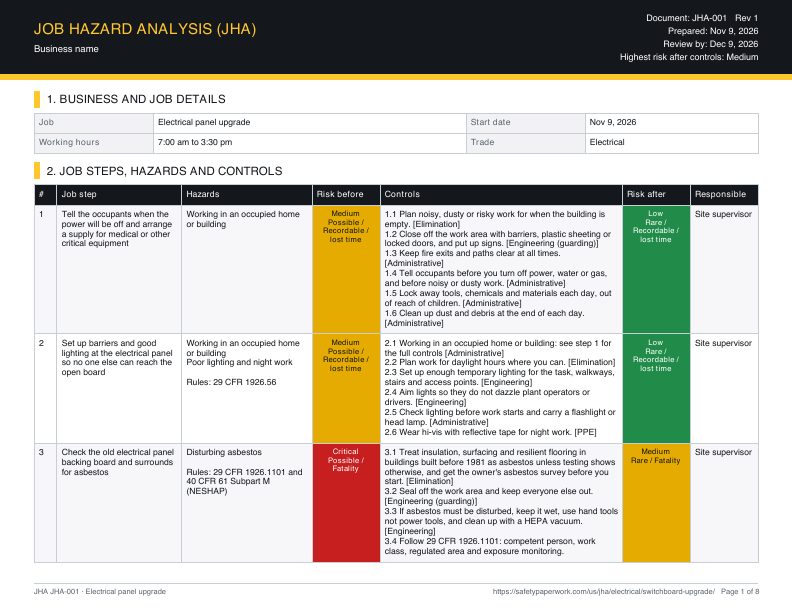
This is a complete JHA for electrical panel upgrade, with 10 job steps. Open it in the builder to add your site, crew and signatures, change anything, and download a PDF. Or download the free Word template below and fill it in by hand.
Job steps, hazards and controls
| # | Job step | Hazards | Risk before | Controls | Risk after |
|---|---|---|---|---|---|
| 1 | Tell the occupants when the power will be off and arrange a supply for medical or other critical equipment |
| Medium |
| Low |
| 2 | Set up barriers and good lighting at the electrical panel so no one else can reach the open board |
| Medium |
| Low |
| 3 | Check the old electrical panel backing board and surrounds for asbestos |
| Critical |
| Medium |
| 4 | Have the utility disconnect the service (pull the meter or cut the service drop), open the main, apply lockout/tagout and test to prove dead. Treat the line side and service conductors as energized until the utility confirms the disconnect (NFPA 70E, 29 CFR 1926.417) |
| Critical |
| Medium |
| 5 | Check the tester on a known live source before and after proving dead |
| Critical |
| Medium |
| 6 | Remove the old electrical panel, labeling every circuit as it comes off |
| Critical |
| Medium |
| 7 | Mount the new enclosure, drilling with dust control and working from a stable step |
| High |
| Medium |
| 8 | Terminate circuits, adding GFCI and AFCI protection where the NEC requires it, and torque connections to the values on the equipment label |
| High |
| Medium |
| 9 | With your lock still on, test insulation resistance, polarity, and grounding and bonding, and check every circuit lands on the right breaker |
| Critical |
| Medium |
| 10 | Get the inspection from the authority having jurisdiction (the utility usually reconnects only after it passes). Remove your lock only when everyone is clear, re-energize, test GFCI and AFCI devices with their test buttons and check voltage at outlets, complete the panel directory and clean up |
| Critical |
| Medium |
PPE
Plant and equipment
Permits and plans
Emergency
Call 911. Add the nearest hospital, the assembly point and the first aid / cpr person for your site.
Sign-off
Supervisor and every worker sign to confirm they have read and understood this JHA.
Free JHA template for electrical panel upgrade
Word (.docx) and PDF, Letter landscape, no email needed. Fill in your site details, then print or send it.
Make yours in 2 minutes
Same document, filled in for your job. Answer a few yes or no questions, the crew signs on the phone, and you send the PDF.
Pre-start checklist for electrical panel upgrade
Tick these off before work starts. They come from the hazards, permits and equipment in this job.
- JHA read, explained and signed by everyone on the job
- Ladder inspected, secured and extending 3 ft above the landing
- Lockout, tagout and test before touch done before work starts
- Asbestos register or survey checked for the work area
- First aid / CPR person, first aid kit and emergency number (911) confirmed
- PPE checked and worn: safety-toe boots (ASTM F2413), safety glasses (ANSI Z87.1), rubber insulating gloves, arc flash PPE (NFPA 70E)
The safe sequence of work
- Tell the occupants when the power will be off and arrange a supply for medical or other critical equipment
- Set up barriers and good lighting at the electrical panel so no one else can reach the open board
- Check the old electrical panel backing board and surrounds for asbestos
- Have the utility disconnect the service (pull the meter or cut the service drop), open the main, apply lockout/tagout and test to prove dead. Treat the line side and service conductors as energized until the utility confirms the disconnect (NFPA 70E, 29 CFR 1926.417)
- Check the tester on a known live source before and after proving dead
- Remove the old electrical panel, labeling every circuit as it comes off
- Mount the new enclosure, drilling with dust control and working from a stable step
- Terminate circuits, adding GFCI and AFCI protection where the NEC requires it, and torque connections to the values on the equipment label
- With your lock still on, test insulation resistance, polarity, and grounding and bonding, and check every circuit lands on the right breaker
- Get the inspection from the authority having jurisdiction (the utility usually reconnects only after it passes). Remove your lock only when everyone is clear, re-energize, test GFCI and AFCI devices with their test buttons and check voltage at outlets, complete the panel directory and clean up
Hazards to watch on electrical panel upgrade
The hazards most specific to this job, and the step where each one comes up.
What changes on your site
This example covers the job itself. Your site may add more. Add controls for any of these that apply (the builder asks you these as yes or no questions):
- Will anyone work 6 feet or more above a lower level?
- Will anyone work on a roof?
- Is there a skylight, fiberglass panel or other fragile roofing?
- Will you use a scaffold or rolling tower?
- Will you use an aerial lift (scissor lift or boom lift)?
Why JHAs get rejected
General contractors send documents back for these reasons. This example avoids them, but check yours too.
- Generic steps such as "work safely" or "use PPE" with no task-specific hazards or controls.
- No OSHA standards referenced for the hazards that have them, such as fall protection, ladders, scaffolds or silica.
- No competent person named for fall protection, excavation, scaffolds or silica where those hazards exist.
- Equipment listed without inspection requirements, and no training listed for the people using it.
- Respirators listed with no respiratory protection program, medical clearance or fit test.
- Controls rely only on PPE when engineering controls such as guardrails, wet cutting or extraction are feasible.
- No crew sign-off, or no date and revision when the job has changed.
Questions
Do I need a JHA for electrical panel upgrade?
OSHA expects employers to find and control hazards on every job, and many general contractors require a written JHA for electrical panel upgrade before you start.
Who signs the JHA?
The supervisor or competent person who prepared it signs, and every crew member signs to show they were trained on the hazards and controls before the job starts. Many general contractors also sign to accept it.
How long do I keep it?
Keep this JHA on site during the job, and keep it with the training and inspection records for at least 1 year after the job (longer if your state plan or general contractor requires it). OSHA does not set a retention period for JHAs themselves.
What PPE is needed for electrical panel upgrade?
Usually Safety-toe boots (ASTM F2413), Safety glasses (ANSI Z87.1), Rubber insulating gloves, Arc flash PPE (NFPA 70E), N95 respirator, High-visibility safety apparel, ANSI/ISEA 107 Class 2 or 3 (Type R near roadways), Half-face respirator (P100 cartridges), Coveralls, Work gloves, Cut-resistant gloves, Hearing protection (earmuffs or plugs), Hard hat (ANSI Z89.1), Knee pads. The site rules may add more, so check with the general contractor.
More electrical JHAs
Related jobs in other trades
Toolbox talks for this job
Blank JHA template: free JHA templates. Also for other countries: Australia (SWMS) · United Kingdom (RAMS) · Canada (FLHA)