SiteSorted
Roofing · United States

JHA for roof replacement

OSHA expects employers to find and control hazards on every job, and many general contractors require a written JHA for roof replacement before you start.

A JHA breaks the job into steps, lists the hazards in each step and the controls that protect the crew, and the crew signs it. The main hazards are falling from a roof edge, falling from height, disturbing asbestos and scaffold collapse or fall from scaffold.

JHA example: roof replacement

This is a complete JHA for roof replacement, with 11 job steps. Open it in the builder to add your site, crew and signatures, change anything, and download a PDF. Or download the free Word template below and fill it in by hand.

Job Hazard Analysis (JHA)
Re-roof: strip and replace a roof · Roofing · Example
Document JHA-001 · Rev 1

Job steps, hazards and controls

#Job stepHazardsRisk beforeControlsRisk after
1Check the asbestos survey. Old roofing felts, cement shingles and roof coatings can contain asbestos; have any asbestos roofing removed first by trained workers under a competent person (29 CFR 1926.1101), using a licensed asbestos contractor where your state requires one
  • Disturbing asbestos
Critical
  • Treat insulation, surfacing and resilient flooring in buildings built before 1981 as asbestos unless testing shows otherwise, and get the owner's asbestos survey before you start. Elimination
  • Seal off the work area and keep everyone else out. Engineering (guarding)
  • If asbestos must be disturbed, keep it wet, use hand tools not power tools, and clean up with a HEPA vacuum. Engineering
  • Follow 29 CFR 1926.1101: competent person, work class, regulated area and exposure monitoring. Administrative
  • Commercial renovation and any demolition need a NESHAP asbestos inspection first, and demolition needs written notice to the state or EPA 10 working days before work starts (40 CFR 61 Subpart M). Administrative
  • Roofing felts, cement shingles and siding, roof coatings and old panel backboards can also contain asbestos. Test them or treat them as asbestos; asbestos roofing is removed intact with hand tools by trained workers (29 CFR 1926.1101(g)(8)). Administrative
  • Stop work straight away if you find suspect asbestos. Do not touch it and tell your supervisor. Administrative
  • Wear a fit-tested NIOSH-approved respirator suited to the work class, and disposable coveralls. PPE
Medium
2Check the weather and power lines, and plan the crane, hoist and dumpster positions
  • Contact with overhead power lines
  • Strong wind and storms
  • Crane and lifting failure
High
  • Ask the utility to de-energize, move or insulate the lines before work starts. Elimination
  • Use non-conductive (fiberglass) ladders near any power lines. Substitution
  • Mark the safe distance with flags, tape or warning lines and keep all equipment and people outside it. Engineering (guarding)
  • Keep equipment at least 10 feet from lines up to 50 kV once the utility confirms the voltage, more for higher voltages, and 20 feet when the voltage is unknown (29 CFR 1926.1408). Administrative
  • Use a dedicated spotter whenever equipment moves or raises anything near lines. Administrative
  • Treat all lines as energized. If equipment touches a line, the operator stays in the cab and everyone else keeps well away. Administrative
  • Check the forecast each morning and plan work at height and lifting around the weather. Elimination
  • Tie down or weigh down loose sheets, panels, boards and rubbish at the end of each shift. Engineering
  • Set wind limits for roof work, platforms and cranes, using the manufacturer's limits, and stop when they are reached. Administrative
  • Stop work and get down in lightning. Wait 30 minutes after the last thunder before going back up. Administrative
  • Check scaffold, fencing and edge protection after strong wind before anyone uses them. Administrative
  • Barricade the lift zone and keep everyone out from under the load. Engineering (guarding)
  • Use a crane rated for the load at the radius, set up on firm ground with outrigger pads. Engineering
  • Check slings, chains, shackles and hooks before use. Remove anything damaged or not tagged. Engineering
  • Plan the lift: weight, radius, ground, path and landing area. Use a written lift plan for complex lifts. Administrative
  • Use a certified crane operator who has also been evaluated by the employer, with the evaluation documented on site (29 CFR 1926.1427), plus a qualified rigger (1926.1425) and a qualified signal person (1926.1428). Administrative
Medium
3Set up fall protection before anyone works on the roof (guardrails or perimeter scaffold, roof brackets with planks, or personal fall arrest on rated anchors), plus a waste chute and an exclusion zone below
  • Falling from a roof edge
  • Scaffold collapse or fall from scaffold
  • Falling tools and materials
  • Public entering the work area
Critical
  • Do what you can from the ground or from a scaffold at the gutter line, for example pre-assemble parts on the ground. Elimination
  • Install edge protection or guardrails on all open roof edges before work starts. Engineering (guarding)
  • Use a perimeter scaffold with handrails and toe boards along the eaves where practical. Engineering
  • Where guardrails cannot be fitted, use fall restraint on certified roof anchors so workers cannot reach the edge. Engineering
  • Low-slope roofs: guardrails, safety nets, personal fall arrest, or a warning line combined with one of these or with a safety monitor (a safety monitor alone only on roofs 50 feet wide or less). Steep roofs: guardrails with toe boards, safety nets or personal fall arrest (29 CFR 1926.501(b)(10), (11)). Administrative
  • Scaffold is built, moved and taken down under the supervision of a competent person. Engineering
  • Fit guardrails, mid rails and toe boards on every platform more than 10 feet above a lower level, or use personal fall arrest (29 CFR 1926.451(g)(1)). Engineering
  • Use mobile scaffolds only on firm, level ground with casters locked, and guy, tie, brace or fit outriggers once the height is more than 4 times the base width (29 CFR 1926.451(c)(1)). Never move one with anyone on it. Engineering
  • Every worker on the scaffold is trained by a qualified person (29 CFR 1926.454). Administrative
  • A competent person inspects the scaffold before each shift and after anything that could affect it (29 CFR 1926.451(f)(3)). Administrative
  • Barricade and sign the drop zone under overhead work so nobody walks beneath. Engineering (guarding)
  • Fit toe boards, kick plates and mesh screens on scaffolds and edges. Engineering
  • Use catch fans, debris netting or covered walkways where people pass below. Engineering
  • Tether hand tools when working at height. Engineering
  • Fence off the site with secure temporary fencing and lock the gates when you leave. Engineering (guarding)
  • Give pedestrians a safe, marked path around the work, with ramps for strollers and wheelchairs. Engineering (guarding)
  • Use hoarding, covered walkways or catch fans where work is above public areas. Engineering
  • Put signs at each entry: site name, contact number and "No unauthorized entry". Administrative
Medium
4Strip the old roof in sections so the building stays covered if rain comes
  • Strong wind and storms
  • Falling through a fragile roof or skylight
  • Lifting and carrying heavy loads
  • Cuts from sharp edges
Critical
  • Do not carry large sheets on roofs in wind. Administrative
  • Wear a hard hat with a chin strap at height in windy conditions. PPE
  • Strong wind and storms: see step 2 for the full controls Administrative
  • Work from underneath or from an aerial lift so nobody stands on the fragile roof. Elimination
  • Cover every skylight with a fixed, marked cover that can hold at least twice the weight it may carry, or guard it with a guardrail. Engineering (guarding)
  • Use crawl boards or staging to spread the load on fragile or rotten decking, and cover or guard any hole left where decking is removed (29 CFR 1926.501(b)(4)). Engineering
  • Use fall arrest on rated anchors when working near fragile areas. Engineering
  • Plan to avoid carrying: have materials delivered, and old items picked up, as close as possible to where they are used. Elimination
  • Use lighter or smaller loads: order smaller bags and shorter lengths, and drain or break down old items before moving them. Substitution
  • Lifting and carrying heavy loads: see step 9 for the full controls Administrative
  • Deburr or cover sharp edges, and fit edge protectors on exposed sheet metal. Engineering
  • Use knives with retractable or self-retracting blades. Engineering
  • Cut away from your body and keep your other hand clear. Administrative
  • Put used blades in a blade bin or sharps container. Administrative
Medium
5Lower waste in an enclosed chute or by crane, never throw it off. An enclosed chute is required when material drops more than 20 feet outside the walls (29 CFR 1926.252(a))
  • Falling tools and materials
  • Crane and lifting failure
  • Poor housekeeping and waste
High
  • Keep platforms tidy. Do not stack materials near edges or above toe board height. Administrative
  • Lower materials with a hoist, chute or rope. Never throw or drop anything down. Administrative
  • Wear a hard hat anywhere objects could fall. PPE
  • Falling tools and materials: see step 3 for the full controls Administrative
  • Use tag lines to control loads and agree on clear radio or hand signals. Administrative
  • Stop lifting in high wind or when the operator cannot see the signal person. Administrative
  • Never ride on a load or hook. Administrative
  • Crane and lifting failure: see step 2 for the full controls Administrative
  • Order materials to size and send packaging back where you can. Elimination
  • Put dumpsters and waste chutes close to the work. Engineering
  • Clean as you go, and do a full clean up at the end of each day. Administrative
  • Keep exits, stairs and walkways clear at all times. Administrative
  • Stack materials neatly on level ground, away from edges. Administrative
Medium
6Check and repair the roof framing, guarding any gaps
  • Structural collapse during alterations
  • Falling from height
Critical
  • Get an engineer to check before removing any wall, beam, post or bracing that may be load-bearing. Elimination
  • Keep everyone clear of the area under and next to the work. Engineering (guarding)
  • Install temporary props, needles or shoring as designed before removing any support. Engineering
  • Follow the engineer's sequence. Do not change it without approval. Administrative
  • Check props daily. Do not remove them until the permanent support is in and approved. Administrative
  • Wear a hard hat and safety boots. PPE
  • Do the work from the ground where you can, for example pre-assemble on the ground or use extension poles. Elimination
  • Install guardrails or edge protection on all open edges before work starts. Engineering (guarding)
  • Falling from height: see step 7 for the full controls Administrative
Medium
7Install underlayment and ice and water shield, staying behind guardrails or tied off, and cover any holes in the deck
  • Falling from height
  • Lifting and carrying heavy loads
Critical
  • Do the work from the ground where you can, for example pre-assemble on the ground or use extension poles. Elimination
  • Install guardrails or edge protection on all open edges before work starts. Engineering (guarding)
  • Use a scaffold, mobile work platform or aerial lift instead of working off a ladder. Engineering
  • Where edge protection is not practical, use a fall restraint or fall arrest system on a rated anchor point. Engineering
  • Provide fall protection at 6 feet or more and train workers to recognize fall hazards (29 CFR 1926.503). Administrative
  • Have a rescue plan so a worker hanging in a harness can be brought down within minutes. Administrative
  • Wear a full body harness with a shock-absorbing lanyard, clipped on at all times when using fall arrest. PPE
  • Use trolleys, pallet jacks, hoists, vacuum lifters or plant instead of carrying by hand. Engineering
  • Use a two-person lift for anything heavy, long or awkward. Plan the route first and clear it. Administrative
  • Lifting and carrying heavy loads: see step 9 for the full controls Administrative
Medium
8Land new roofing materials by crane or hoist, spreading loads across the frame
  • Crane and lifting failure
  • Structural collapse during alterations
High
  • Wear a hard hat, hi-vis, gloves and safety boots. PPE
  • Crane and lifting failure: see step 2 for the full controls Administrative
  • Structural collapse during alterations: see step 6 for the full controls Administrative
Medium
9Lay the new roof, taking breaks in heat and sun
  • Lifting and carrying heavy loads
  • Heat stress
  • Sun exposure (UV)
High
  • Plan to avoid carrying: have materials delivered, and old items picked up, as close as possible to where they are used. Elimination
  • Use lighter or smaller loads: order smaller bags and shorter lengths, and drain or break down old items before moving them. Substitution
  • Use trolleys, pallet jacks, hoists, vacuum lifters or plant instead of carrying by hand. Engineering
  • Use a two-person lift for anything heavy, long or awkward. Plan the route first and clear it. Administrative
  • Keep the load close, back straight and no twisting. Turn with your feet. Administrative
  • Schedule heavy work for the cooler part of the day. Elimination
  • Provide shade over work and rest areas, and fans or cooling in attics. Engineering
  • Supply cool drinking water close by and drink a cup every 15 to 20 minutes. Administrative
  • Take regular rest breaks in the shade, more often as it gets hotter. Administrative
  • Let new and returning workers build up to full work in the heat over about a week. Administrative
  • In California, Washington, Oregon and Maryland, follow the state heat illness rule: written plan, shade, water, rest and high-heat procedures. Administrative
  • Plan outdoor work for early morning or late afternoon when UV is lower. Elimination
  • Put shade covers over fixed work areas. Engineering
  • Check the UV index each day. Use sun protection when it is 3 or higher. Administrative
  • Check your skin regularly and see a doctor about any new or changing spots. Administrative
  • Wear a broad-brim hat or hard hat brim, long sleeves, sunglasses and SPF 30 or higher sunscreen, reapplied every 2 hours. PPE
Medium
10Fit flashings, ridge cap, gutters and downspouts
  • Injury from power tools
  • Angle grinder injuries
  • Cuts from sharp edges
High
  • Keep all guards fitted and working. Never tie back or remove a guard. Engineering
  • Clamp or secure the work piece. Do not hold it by hand. Engineering
  • Only trained, competent people use power tools, following the maker's instructions. Administrative
  • Check tools before use. Unplug or remove the battery before changing blades or bits. Administrative
  • No loose clothing, jewelry or long hair near spinning parts. Administrative
  • Use a guarded saw or a different tool where you can. Substitution
  • Keep the guard on and use the side handle. Never remove the guard. Engineering
  • Use the right disc for the job, rated for the grinder's speed. Check it for cracks first. Administrative
  • Only trained people change discs, with the grinder unplugged or the battery out. Administrative
  • Keep both hands on the grinder and let the disc stop before putting it down. Administrative
  • Use two people to handle large sheets of metal or glass. Administrative
  • Wear cut-resistant gloves and long sleeves. PPE
  • Cuts from sharp edges: see step 4 for the full controls Administrative
Medium
11Clean the roof and site, then dismantle scaffold once the roof is signed off
  • Poor housekeeping and waste
  • Scaffold collapse or fall from scaffold
Critical
  • Wear gloves when handling waste. PPE
  • Poor housekeeping and waste: see step 5 for the full controls Administrative
  • Do not overload platforms. Know the rated load (light, medium or heavy duty) and stack materials over the legs, not mid-span (29 CFR 1926.451(f)(1)). Administrative
  • Never remove ties, braces, guardrails or planks. Only the erection crew alters the scaffold, under the direction of the competent person (29 CFR 1926.451(f)(7)). Administrative
  • Wear a hard hat and safety boots on and around the scaffold. PPE
  • Scaffold collapse or fall from scaffold: see step 3 for the full controls Administrative
Medium

PPE

Safety-toe boots (ASTM F2413)Personal fall arrest system (harness)Hard hat (ANSI Z89.1)Cut-resistant glovesSafety glasses (ANSI Z87.1)N95 respiratorHearing protection (earmuffs or plugs)Sun protection (sunscreen, hat, long sleeves)Half-face respirator (P100 cartridges)CoverallsWork glovesHigh-visibility safety apparel, ANSI/ISEA 107 Class 2 or 3 (Type R near roadways)Face shield (ANSI Z87.1)

Plant and equipment

Supported scaffold: Erected under a competent person (29 CFR 1926.451)Mobile crane: Operator certified by an accredited body or audited employer program (29 CFR 1926.1427) and evaluated by the employer, with a signed evaluation on site (1926.1427(f)); qualified rigger (1926.1425) and qualified signal person (1926.1428)Telehandler: Trained and evaluated operator, certified by the employer with name, training date, evaluation date and evaluator; re-evaluated every 3 years (29 CFR 1910.178(l), via 1926.602(d)). If used to hoist a suspended load with a winch or jib, crane rules apply (29 CFR 1926 Subpart CC)Angle grinderPower drillTrailer

Permits and plans

Critical lift planWritten fall protection plan (only where guardrails, nets or personal fall arrest are not feasible, 1926.502(k))

Emergency

Call 911. Add the nearest hospital, the assembly point and the first aid / cpr person for your site.

Sign-off

Supervisor and every worker sign to confirm they have read and understood this JHA.
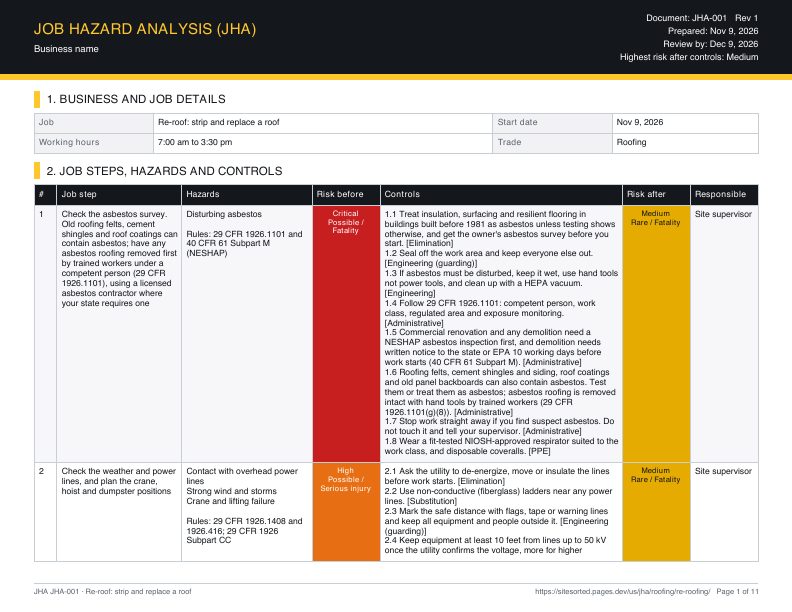
Page 1 of the free roof replacement JHA template: business details, job steps with hazards, risk ratings and controls

Free JHA template for roof replacement

Word (.docx) and PDF, Letter landscape, no email needed. Fill in your site details, then print or send it.

Make yours in 2 minutes

Same document, filled in for your job. Answer a few yes or no questions, the crew signs on the phone, and you send the PDF.

Start this JHA

Pre-start checklist for roof replacement

Tick these off before work starts. They come from the hazards, permits and equipment in this job.

The safe sequence of work

  1. Check the asbestos survey. Old roofing felts, cement shingles and roof coatings can contain asbestos; have any asbestos roofing removed first by trained workers under a competent person (29 CFR 1926.1101), using a licensed asbestos contractor where your state requires one
  2. Check the weather and power lines, and plan the crane, hoist and dumpster positions
  3. Set up fall protection before anyone works on the roof (guardrails or perimeter scaffold, roof brackets with planks, or personal fall arrest on rated anchors), plus a waste chute and an exclusion zone below
  4. Strip the old roof in sections so the building stays covered if rain comes
  5. Lower waste in an enclosed chute or by crane, never throw it off. An enclosed chute is required when material drops more than 20 feet outside the walls (29 CFR 1926.252(a))
  6. Check and repair the roof framing, guarding any gaps
  7. Install underlayment and ice and water shield, staying behind guardrails or tied off, and cover any holes in the deck
  8. Land new roofing materials by crane or hoist, spreading loads across the frame
  9. Lay the new roof, taking breaks in heat and sun
  10. Fit flashings, ridge cap, gutters and downspouts
  11. Clean the roof and site, then dismantle scaffold once the roof is signed off

Hazards to watch on roof replacement

The hazards most specific to this job, and the step where each one comes up.

Step 4Falling through a fragile roof or skylightA worker steps on a skylight, clear sheet or old fiber cement roof and falls through to the floor below.
Step 2, 5, 8Crane and lifting failureA load falls or swings, or the crane tips, crushing workers under or near the lift.
Step 10Angle grinder injuriesThe disc shatters, binds or kicks back, causing deep cuts to legs and hands or eye injuries.
Step 3, 11Scaffold collapse or fall from scaffoldA scaffold that is badly built, overloaded or altered collapses or tips, or a worker falls from an unguarded platform.
Step 9Sun exposure (UV)Long hours in the sun cause sunburn, eye damage and skin cancer.
Step 2Contact with overhead power linesA ladder, aerial lift, crane, dump truck or long length of material touches or gets close to an overhead line and electrocutes people.
Almost certainLikelyPossibleUnlikelyRareHow bad it could be: First aid only to FatalityBA
Highest risk on roof replacement: Critical before controls (B), down to Medium after controls (A), on the United States 5 by 5 risk matrix (likely and fatality becomes unlikely and serious injury).

What changes on your site

This example covers the job itself. Your site may add more. Add controls for any of these that apply (the builder asks you these as yes or no questions):

  • Will anyone use a ladder or stepladder?
  • Will you use an aerial lift (scissor lift or boom lift)?
  • Is it a home or child-occupied facility (such as a child care center or preschool) built before 1978, and will you disturb paint?
  • Will you cut, grind or drill concrete, brick, stone, tile or fiber cement?
  • Will you use chemicals, solvents, glues, paints or fuels?

Licences and legal requirements in United States

Equipment on this job that needs a licence, ticket or training:

  • Supported scaffold: Erected under a competent person (29 CFR 1926.451)
  • Mobile crane: Operator certified by an accredited body or audited employer program (29 CFR 1926.1427) and evaluated by the employer, with a signed evaluation on site (1926.1427(f)); qualified rigger (1926.1425) and qualified signal person (1926.1428)
  • Telehandler: Trained and evaluated operator, certified by the employer with name, training date, evaluation date and evaluator; re-evaluated every 3 years (29 CFR 1910.178(l), via 1926.602(d)). If used to hoist a suspended load with a winch or jib, crane rules apply (29 CFR 1926 Subpart CC)

OSHA requires employers to find and fix hazards and to train workers on them. A JHA breaks the job into steps, lists the hazards in each step and the controls that protect the crew. General contractors often require one before you start.

Rules that apply: 29 CFR 1926.1101 and 40 CFR 61 Subpart M (NESHAP); 29 CFR 1926.1408 and 1926.416; 29 CFR 1926 Subpart CC; 29 CFR 1926 Subpart M; 29 CFR 1926 Subpart L; 29 CFR 1926.501(c); OSH Act Section 5(a)(1) General Duty Clause; state heat rules where they apply (Cal/OSHA T8 3395, WA WAC 296-62-095, OR OAR 437-002-0156, MD COMAR 09.12.32); 29 CFR 1926 Subpart I.

Why JHAs get rejected

General contractors send documents back for these reasons. This example avoids them, but check yours too.

  • Generic steps such as "work safely" or "use PPE" with no task-specific hazards or controls.
  • No OSHA standards referenced for the hazards that have them, such as fall protection, ladders, scaffolds or silica.
  • No competent person named for fall protection, excavation, scaffolds or silica where those hazards exist.
  • Equipment listed without inspection requirements, and no training listed for the people using it.
  • Respirators listed with no respiratory protection program, medical clearance or fit test.
  • Controls rely only on PPE when engineering controls such as guardrails, wet cutting or extraction are feasible.
  • No crew sign-off, or no date and revision when the job has changed.

Questions

Do I need a JHA for roof replacement?

OSHA expects employers to find and control hazards on every job, and many general contractors require a written JHA for roof replacement before you start.

Who signs the JHA?

The supervisor or competent person who prepared it signs, and every crew member signs to show they were trained on the hazards and controls before the job starts. Many general contractors also sign to accept it.

How long do I keep it?

Keep this JHA on site during the job, and keep it with the training and inspection records for at least 1 year after the job (longer if your state plan or general contractor requires it). OSHA does not set a retention period for JHAs themselves.

What PPE is needed for roof replacement?

Usually Safety-toe boots (ASTM F2413), Personal fall arrest system (harness), Hard hat (ANSI Z89.1), Cut-resistant gloves, Safety glasses (ANSI Z87.1), N95 respirator, Hearing protection (earmuffs or plugs), Sun protection (sunscreen, hat, long sleeves), Half-face respirator (P100 cartridges), Coveralls, Work gloves, High-visibility safety apparel, ANSI/ISEA 107 Class 2 or 3 (Type R near roadways), Face shield (ANSI Z87.1). The site rules may add more, so check with the general contractor.

More roofing JHAs

Related jobs in other trades

Toolbox talks for this job

Blank JHA template: free JHA templates. Also for other countries: Australia (SWMS) · United Kingdom (RAMS) · Canada (FLHA)

Sources