Free Job Hazard Analysis (JHA) Template
A job hazard analysis breaks a job into steps, lists the hazards in each step, and records the controls that protect the crew. This template follows the sample form in OSHA's own JHA guide (OSHA 3071), with the extra fields general contractors usually ask for. OSHA does not mandate a JHA form, but it is a common way to show you found the hazards, trained your workers and met the standards that apply.
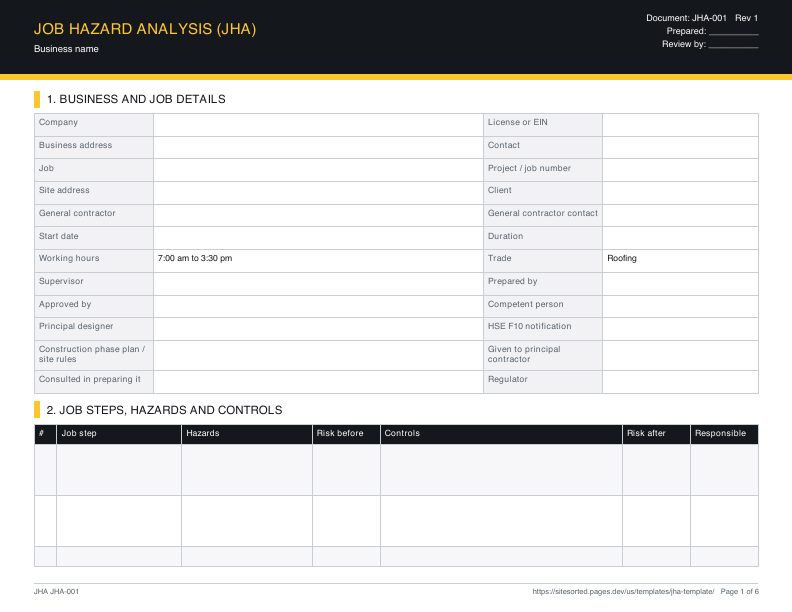
Job Hazard Analysis template
Word (.docx, editable) and PDF (Letter, print ready). No email needed.
When you need a JHA
- No federal OSHA standard requires a document called a JHA for construction. Employers must keep the workplace free from recognized hazards likely to cause death or serious physical harm (OSH Act Section 5(a)(1)) and comply with OSHA standards (Section 5(a)(2)).
- Construction employers must run programs that include frequent and regular inspections of job sites, materials and equipment by competent persons (29 CFR 1926.20(b)(1) and (2)).
- Every employee must be instructed in recognizing and avoiding unsafe conditions and in the regulations that apply to their work (29 CFR 1926.21(b)(2)). A JHA is a practical record of what was covered.
- General contractors, owners and insurers often require a JHA (or a JSA or AHA) in the subcontract before you mobilize.
- OSHA 3071 says to do JHAs first for jobs with high injury rates, jobs that could cause severe injury, jobs where one human error could be serious, new or changed jobs, and jobs complex enough to need written instructions.
What goes in each field
| Field | What to write | Example |
|---|---|---|
| Job title and location | The task being analyzed and where it is done. | Replace damaged concrete roof tiles, 418 Alder Ct, two-story house |
| Analyst and date | Who prepared the JHA and when. Add a revision date each time it is updated. | Prepared by Luis Ortega, foreman, 3/3/2026, rev 1 |
| Company, GC and competent person | Your company, the general contractor, and the competent person who inspects the site and equipment. | Summit Roofing LLC for Baker Homes; competent person (fall protection): Luis Ortega |
| Job steps | The job broken into steps in the order they happen. Not so detailed it becomes a manual, not so broad it skips basic steps. | 1. Set ladder. 2. Install anchor and walk boards. 3. Remove broken tiles. 4. Cut new tiles. 5. Set tiles. |
| Hazard type and description | For each step: what can go wrong, how it could happen, and who is exposed. | Fall: slipping on wet tiles near the eave, 14 ft to the driveway |
| Consequence | The likely result if the hazard happens. | Fracture, head injury or death |
| Hazard controls | Controls for each hazard, most effective first: elimination, substitution, engineering, administrative, then PPE. | Guardrail or personal fall arrest from 6 ft (1926.501(b)(13)); saw with integrated water feed for tile cutting (1926.1153 Table 1) |
| Risk before and after | Optional rating of likelihood and severity, before and after controls. Many GCs ask for it. | Before: Likely x Fatality = Critical. After: Rare x Fatality = Medium |
| Equipment, inspections and training | Equipment used, who inspects it and when, and the training each worker needs. | Type IA ladder, inspected before use; harness and lanyard, inspected daily; all crew fall protection trained |
| Rationale or comment | Why a control was chosen, or why a higher control was not feasible. | No guardrail at the rake because of the gable overhang; PFAS with ridge anchor used instead |
| Crew review and signatures | Names and signatures of the workers who reviewed the JHA before starting. | Reviewed with crew 3/3/2026: L. Ortega, D. Kim, J. Ruiz |
How to fill it in
- Pick the job and walk it with the workers who do it. OSHA 3071 says involving employees is the first step.
- Review past injuries and near misses on this kind of work.
- Break the job into steps, watching the work if you can, and write them in order.
- For each step, ask what can go wrong, what the result would be, how it could happen and how likely it is.
- Choose controls for each hazard using the hierarchy of controls, and check the OSHA standards that apply to that hazard.
- List equipment, inspections, training and the competent person.
- Review the JHA with the crew before work starts and get signatures.
- Review it again after any injury, near miss or change in the job, and retrain the crew on the changes.
Why JHAs get rejected
- Generic steps such as "work safely" or "use PPE" with no task-specific hazards or controls.
- No OSHA standards referenced for the hazards that have them, such as fall protection, ladders, scaffolds or silica.
- No competent person named for fall protection, excavation, scaffolds or silica where those hazards exist.
- Equipment listed without inspection requirements, and no training listed for the people using it.
- Respirators listed with no respiratory protection program, medical clearance or fit test.
- Controls rely only on PPE when engineering controls such as guardrails, wet cutting or extraction are feasible.
- No crew sign-off, or no date and revision when the job has changed.
Filled JHA examples
Questions
Is a free JHA template OSHA compliant?
OSHA does not approve or require any particular JHA form, so no template is compliant by itself. What OSHA enforces is the hazards: the standards that apply to your work and the General Duty Clause. A free template is fine if you fill it in with the real steps, hazards and controls for the job and the controls meet the standards.
Source: OSH Act Section 5, duties
Can I use a generic JHA?
Only as a starting point. OSHA 3071 notes that its example job procedures do not include every step, hazard and protection for your industry, and tells you to consult the OSHA standards for your work. Edit a generic JHA for the site, the equipment and the crew before using it.
Source: OSHA 3071 Job Hazard Analysis
Does a JHA need a risk matrix?
No, OSHA's JHA guide does not require a risk matrix. It asks you to judge how likely a hazard is and how severe the consequence would be. Some GCs and agency contracts require a rating, so add one if your contract asks for it.
Source: OSHA 3071 Job Hazard Analysis
Who should fill out a JHA?
A supervisor or foreman usually writes it, together with the workers who do the job. OSHA 3071 is written for employers, foremen and supervisors, and says to involve employees in every phase, from listing the steps to choosing the controls.
Source: OSHA 3071 Job Hazard Analysis
Do it on your phone instead
Fill it in by tapping, the crew signs with a finger, and you get a clean PDF.